 Jun 05,2026
A fleet operator investing in depot charging for electric trucks faces a fundamental question: megawatt capability or CCS with power sharing? The decision in 2026 is rarely about connector compatibility—it‘s about throughput versus dwell time, and what your site can economically sustain. If your operation is built around tight turnaround windows (often under 60 minutes) and revenue depends on vehicle availability, a MCS charger can be justified—provided you have the grid capacity and thermal stability to deliver megawatt-class power repeatedly. If vehicles naturally dwell longer, or utilization is uneven, CCS with power sharing often produces a better outcome: lower peak exposure, simpler maintenance, and less risk of stranded assets. Many Class 8 trucks are now dual‑inlet capable, so the decision is a strategic choice, not a technical barrier. This guide walks through the six key decision drivers that determine which approach fits your operation.
The primary driver: how long trucks actually sit
The single most important factor is natural dwell time. If your depot sees trucks arriving with predictable turnaround windows and tight dispatch schedules—often under 60 minutes—a megawatt charger can protect route density and asset utilization, provided the site can sustain that power delivery without chronic de‑rating. If vehicles dwell for hours overnight, a CCS setup with power sharing frequently delivers better cost per delivered kWh and simpler operations. Fast charging is only valuable when it converts directly into measurable fleet productivity, not just shorter charging time. For mixed operations—some lanes time‑critical, others not—a hybrid approach often works best.
The grid reality that stops most MCS projects
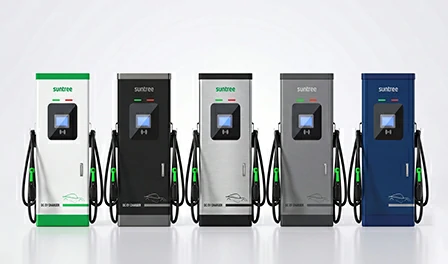
Megawatt charging pushes sites toward medium‑voltage interconnection far earlier than CCS, meaning longer utility coordination cycles and higher pre‑construction risk. In many regions, transformer lead times and permit approvals stretch to 18–24 months. If your project timeline is constrained and grid upgrades are uncertain, CCS can be deployed in phases and scaled incrementally. If you already have MV capacity, available transformer slots, and predictable commissioning windows, megawatt charging becomes feasible. Many so‑called “MCS failures” are actually grid failures—the charger delivered, but the utility couldn’t. Suntree‘s modular platform, including the SSJ5E Pro/Max (120kW to 240kW), SSJ3E (60kW to 120kW), SSJ4E (40kW to 120kW), and SSJ5E (60kW to 360kW), supports phased site growth—deploy CCS capacity now, reserve headroom, and add MCS later without re‑engineering the entire site.
Why demand charges turn megawatt peaks into billing nightmares
Demand charges bill you on the single highest peak within a billing period. A single 1.2 MW megawatt session—perhaps to recover a delayed truck—can set that peak and trigger month‑long penalties. Without battery storage or strict concurrency controls, that penalty can erase the margin from dozens of successful sessions. High demand‑charge regions strongly favor CCS with power sharing and peak‑aware scheduling. Suntree’s AC chargers—SWJ3E (7kW to 22kW), SWG7 (7kW to 22kW), SWG5E, SWJ7E/SWJ6E (7kW to 22kW), SCJ4/5 (7kW to 22kW), SPJ2E (11kW to 22kW), SPJ3E (3.5kW to 7kW), and SPG3E (7kW to 22kW)—support dynamic load balancing to cap peaks while maintaining throughput. A megawatt charger can work in high demand‑charge markets only when you can tightly control concurrency and when peaks translate directly into revenue or SLA value. If your tariff punishes peaks and you can‘t control them, megawatt charging becomes an expensive way to buy billing penalties.
The underutilization trap: buying megawatts you can’t monetize
A megawatt dispenser is not a bigger CCS. It’s an industrial asset class with higher capex, higher commissioning burden, and higher O&M expectations—liquid cooling, tighter tolerances, more expensive downtime. If utilization is not consistently high, the economics collapse quickly. If trucks naturally dwell for hours or arrive in uneven bursts, CCS power sharing can still deliver the daily energy requirement with better queue dynamics. If your dispatch is variable or seasonal, an MCS lane often sits idle while still carrying depreciation and maintenance overhead. Even in fleets that “want faster charging,” the real constraint is often staging, loading, driver shift constraints, or yard flow—not electrical power. MW capacity only pays back when it reduces measurable operational cost or generates revenue tied to fast turnaround. This is where a modular growth strategy matters: Suntree’s SSJ series supports sharing algorithms that let you add chargers in stages, scaling power as fleet volume proves itself rather than betting big upfront.
The overlooked factor: cables dictate site layout
The most underestimated factor in megawatt planning is cable handling. Megawatt cables and dispensers are not just “thicker wires.” They are industrial components with stiffness, bend radius constraints, mass, and cooling interfaces that directly impact stall spacing, lane width, and vehicle approach tolerance. The weight and rigidity of a high‑current cable mean plug‑in time isn‘t just about electricity—it’s about physical handling. Without counterweights, overhead booms, or disciplined cable management, sites risk repetitive strain injuries, higher incident rates, and measurable downtime from human friction. Megawatt charging frequently pushes depots toward drive‑through lanes or controlled bay geometries because cable handling is a throughput constraint. CCS is generally more forgiving in tight footprints and back‑in stalls. For mixed sites, Suntree‘s complete energy ecosystem—from EV charging to solar conversion—helps operators integrate charging without forcing a full site redesign.
Decision scenarios: which path fits your operation
| Scenario | CCS – Best Fit When… | Megawatt – Best Fit When… | Primary Risk of Wrong Choice |
|---|---|---|---|
| Mid‑route stops | Stops aren’t consistently time‑critical; power sharing across stalls maintains throughput | Turnaround is strictly constrained and tied to revenue; grid supports repeated MW ramps | CCS: missed targets; MW: demand‑charge spikes dominate OPEX |
| Overnight depot | Vehicles dwell hours, enabling energy delivery via shared DC cabinets; simpler O&M | Only justified if depot still runs tight dispatch windows or needs fast lanes for exceptions | MW: stranded capex + unnecessary thermal complexity |
| Limited grid capacity | Site must scale in phases; CCS allows staged growth and better concurrency control | Rarely optimal unless paired with strong peak mitigation and strict concurrency limits | MW: “paper MW” that can‘t be delivered; frequent de‑rating |
| High demand‑charge region | Power sharing reduces peak exposure; easier to enforce site‑wide caps | Only works if peaks are monetized and controlled (battery storage, dispatch discipline) | MW: peak events become billing events; ROI collapses |
| Mixed‑fleet operations | CCS provides broad compatibility and lower geometric constraints | Use selectively for time‑critical lanes; hybrid operations are now practical | Single‑technology choice: operational bottlenecks or overbuilt infrastructure |
When megawatt charging becomes a bad investment
Two traps kill megawatt ROI in 2026. The first is the underutilization trap. You buy megawatts even when you can‘t monetize them. If trucks naturally dwell for hours or arrival patterns are uneven, CCS power sharing still delivers the required daily energy. The second is the peak penalty trap: a single high‑power session sets your billing peak, and demand charges persist for the entire billing cycle. Without battery storage or strict concurrency limits, megawatt charging can convert “rare exceptions” into recurring monthly penalties. If your business case assumes “we’ll only use the megawatt lane occasionally,” that‘s a red flag—the tariff may still bill you as if you are a megawatt‑class site.
Why distributed stalls often beat a single megawatt plug
A charging site creates value when its available grid capacity is productively used for more hours of the day, across more vehicles, with fewer interruptions. This is why multi‑stall CCS layouts often outperform single‑lane megawatt layouts when arrival patterns are uneven. In real depots, installed power is rarely used at 100% all the time. The real performance lever is how often multiple vehicles can charge in parallel without forcing the site into extreme peak events. Four 250kW CCS stalls can absorb arrival randomness: more vehicles can be served in parallel at moderate power, with power sharing keeping peaks bounded. One 1MW megawatt lane concentrates service into one bay; when it runs, it creates full‑peak events; when occupied, it becomes a bottleneck unless alternate lanes exist. In many fleet yards, distributed stalls increase queuing efficiency and reduce operational fragility. Megawatt charging can still be justified—but typically as a targeted lane for true time‑critical operations, not as the only strategy.
deployment patterns that actually work
The most reliable outcomes come from patterns that respect grid constraints, tariff reality, and operational variability. The default low‑regret pattern for depots scaling over time is CCS‑first, MCS‑ready. Deploy CCS lanes first using shared DC power cabinets and power‑sharing algorithms to maximize concurrency and queuing efficiency. Engineer the site as MCS‑ready: reserve conduit routes, pad space, cable corridors, and protection headroom. Treat MV upgrades as a phased roadmap, designing the MV room, transformer bay, and switchgear lineup so an MCS lane can be added without rework. Use early operating data—arrival distribution, dwell profiles, tariff exposure—to determine whether and where megawatt capability creates real value. For a typical regional hub, a 4:1 ratio (four 250kW CCS stalls plus one MCS lane) often delivers the best balance between high‑volume daily energy and a dedicated fast‑turnaround lane for exceptions.
For high‑throughput hubs where turnaround is contractually constrained, build around a grid‑first architecture: MV interconnect, step‑down transformers, coordinated protection, and industrial commissioning plans. Use dedicated MCS lanes for time‑critical vehicles while CCS lanes handle baseline energy delivery and traffic smoothing. Design yard geometry around industrial cable handling—drive‑through lanes are often favored to reduce bay occupancy time. Operationalize throughput with defined availability metrics, spares strategy, and thermal maintenance discipline defined before go‑live.
Suntree‘s approach to future‑ready charging infrastructure
Suntree has been a global provider of solar and EV charging solutions since 2007, focusing on New Energy, Smart Power, and Grid Technologies. With 100+ R&D personnel, 20+ production lines, and full CE, TUV, UL, RoHS, and UKCA certifications, Suntree‘s equipment meets global market access standards. Trusted by 3,000+ clients across 110+ countries, with 24 branch offices in Sweden as a European hub, Suntree offers competitive pricing, technical training, and dedicated support for distributors, installers, and system integrators.
The DC fast charger portfolio—SSJ5E Pro/Max (120kW–240kW), SSJ3E (60kW–120kW), SSJ4E (40kW–120kW), and SSJ5E (60kW–360kW)—supports multi‑charger site layouts and phased expansion. AC chargers—SWJ3E (7kW–22kW), SWG7, SWG5E, SWJ7E/SWJ6E, SCJ4/5 (all 7kW–22kW), SPJ2E (11kW–22kW), SPJ3E (3.5kW–7kW), and SPG3E (7kW–22kW)—support workplace, residential, and retail applications with integrated load management. Real deployments in North Macedonia, Malaysia, Switzerland, and Timor‑Leste demonstrate global execution capability. Whether you need CCS for baseline delivery today or a clear path to MCS tomorrow, Suntree‘s modular platform helps you avoid rip‑and‑replace cycles.
→ Request a site‑specific MCS/CCS strategy from Suntree — Share your depot type, target turnaround windows, and current grid capacity. Their technical experts will recommend the right charger mix, expansion roadmap, and storage integration to match your fleet’s operational realities.