 Jun 12,2026
Installing more chargers doesn’t always mean you can serve more vehicles. The real constraint isn‘t physical space on the site—it’s the power connection from the utility. Transformers, switchgear, and contracted capacity impose hard limits that no amount of hardware can bypass. Dynamic power management solves a different problem: how to use the power you already have in a smarter way. Instead of letting some chargers sit idle while others are overloaded, or forcing drivers to wait for an oversized charging point to become free, operators can continuously balance power across the entire site as vehicles arrive, depart, or change their charging demand. This guide explains why DC fast charging sites need real‑time power allocation, how the technology works, and how Suntree’s scalable platform helps operators meet growing demand without waiting years for grid upgrades.
Three constraints every DC charging site faces
Even when there’s physical space to add more chargers, three limitations keep operators from scaling freely.
Grid and transformer limits. A site is bound by its contracted power capacity, transformer rating, switchgear limits, and acceptable power ramp behavior. Without site‑level control, several vehicles drawing high power simultaneously can push the site toward overload, trip protection devices, or simply behave unpredictably. In many industrial and commercial settings, a no‑export requirement also applies—power cannot flow back to the grid. Where solar PV, storage, and charging coexist, dynamic power management becomes essential for coordinating these assets.
Uneven arrival patterns. DC charging demand is rarely smooth. Sites experience wave‑like peaks, mixed vehicle types with different charging acceptance, and short sessions alongside long ones. A fixed allocation model wastes capacity during quiet periods and becomes a bottleneck the moment the site gets busy. Most underperforming sites don‘t lack installed chargers—they lack a way to turn installed kW into consistently deliverable charging capacity.
Peak demand and instability. High‑power DC charging brings three problems together: higher peak demand costs, random failures during busy hours, and a heavier support burden when “the site only breaks at peak times.” As liquid‑cooled charging power continues to rise, single‑connector output keeps climbing. If two vehicles begin high‑power charging at the same time, the site can quickly approach transformer or distribution limits. Real‑time power management is becoming the safety foundation of large‑scale ultra‑fast charging, helping high‑power sites stay controllable and operational even under heavy load.
What dynamic power management actually does
In DC fast charging, dynamic power management typically includes three functions. First, set a site‑wide power limit that defines the maximum the site should draw or deliver. Second, distribute that available power across active chargers and connectors based on a chosen control logic. Third, adjust continuously in real time as vehicles connect, disconnect, or change their charging demand. This isn‘t about making one charger look better on paper. It’s about turning the site into a system that can allocate, coordinate, and protect power in real time. The higher the power level, the less useful static thinking becomes.
How the control loop works
Most DC sites follow a simple control loop. First, the system monitors the site‘s available power limit, current charging load, charger and connector status, and in some cases other site loads as well. This sounds straightforward, but it’s often where projects begin to struggle. If a site cannot clearly see its own real limits, later control decisions become reactive rather than precise.
Second, power is distributed based on rules. Common approaches include equal sharing, priority‑based allocation, minimum guaranteed power per session, and dispatch or departure‑time‑based allocation for fleets. This is not only a technical function—it‘s also a business tool. Operators can use it to create different service levels. For example, a logistics fleet might be guaranteed at least 60 kW to protect departure schedules, while public users receive flexible power based on what remains available. This allows the site to protect important customers while still turning spare capacity into revenue.
Third, the system keeps the site stable by maintaining total power below the site limit, controlling how fast power changes, and helping the site behave more predictably under fluctuating conditions. The key point is this: dynamic power management is not about making every car charge faster. It is about making the site itself more stable, easier to scale, and more productive under real operating conditions.
What changes with dynamic management
| Site Characteristic | Without Dynamic Management | With Dynamic Management |
|---|---|---|
| Power control | Higher risk of hitting grid or distribution limits when several vehicles charge at high power | Power is distributed within a site‑wide cap, reducing overload risk |
| Utilization | Some chargers overload while others sit underused | Real‑time allocation improves overall utilization |
| Peak‑hour stability | Higher risk of protection trips, unstable behavior, or random failures | Power changes are controlled more smoothly, improving predictability |
| Scalability | Grid upgrades needed earlier | More charging points can often be supported within existing limits |
| Response to uneven arrivals | Hard to manage bursty traffic or mixed demand | Better suited to fluctuating traffic and mixed sessions |
| Fleet priority control | Difficult to protect critical vehicles or guaranteed service levels | Priority rules can be applied for fleets or high‑value users |
| Solar + storage integration | Harder to coordinate charging with other energy assets | Easier to coordinate PV, storage, and charging loads together |
Five benefits that show up on the bottom line
More chargers without waiting for a transformer upgrade. When utility upgrades take 18–24 months, dynamic power management helps operators serve more vehicles within the same site limit, unlocking growth before the next power upgrade is complete.
Higher utilization of existing power. Instead of leaving capacity unused while one charger is overloaded, dynamic allocation helps use available capacity more continuously and efficiently.
Better throughput and shorter queue times. In real operations, more connectors plus dynamic allocation often outperform one oversized charging point. More vehicles can start charging, peak traffic becomes easier to manage, and the site is less likely to be blocked by one long session.
Fewer peak‑hour failures. By limiting peaks and controlling how power changes, operators can reduce nuisance trips, overload events, and the kind of failures that appear only when the site is busy.
Smoother integration of solar and storage. In sites with rooftop PV and battery storage, the system can monitor solar output and battery state of charge in real time, then use that extra power to support charging sessions without breaking the site‘s grid limit.
Where dynamic power management matters most
Public DC charging hubs. Sites with multiple chargers, mixed traffic, and bursty arrivals benefit from better throughput and more stable operation.
Fleet depots and mixed‑use sites. Vehicles often return in waves. Real‑time allocation helps prioritize charging, protect site limits, and keep the yard moving.
Sites with limited grid capacity or long upgrade lead times. Where medium‑voltage expansion, transformers, or switchgear are constrained, dynamic power management helps the site scale before a major power upgrade is completed.
Solar‑plus‑storage‑plus‑charging installations. As energy orchestration becomes a major trend in 2026, dynamic management is moving beyond “charger control” and toward full site energy management—monitoring PV output and battery state of charge, then using that extra capacity to support charging sessions without breaking grid limits.
Common questions about power management
Q: Does dynamic power management make every vehicle charge faster?
Not necessarily. Its main purpose is to improve site‑level throughput and stability, not to maximize every single session at all times. In practice, it often increases overall site productivity even if individual peak speeds occasionally adjust.
Q: Is this just a hardware upgrade?
No. Dynamic power management is a site‑level control strategy. It depends on coordination, rules, and system behavior—not only on larger cabinets or thicker cables.
Q: Can I set it and forget it?
Not really. Good results depend on clear operating rules: minimum power guarantees, priority logic, safe power change limits, and fallback behavior under abnormal conditions. It is better understood as part of the site’s operating system, not as a simple feature switch.
Q: Is it only useful for AC charging?
No. It is highly relevant for DC fast charging, where power levels are higher, demand is more uneven, and the cost of overloads or trips is much greater.
Q: What’s the biggest mistake when enabling dynamic management?
Treating it as a speed upgrade. The real value comes from using it as a site management strategy: minimum power rules, priority logic, safe limits, and a phased expansion plan all matter more than peak speed numbers.
How Suntree approaches scalable charging
Suntree has been a global provider of solar and EV charging solutions since 2007, focusing on three core areas: New Energy, Smart Power, and Grid Technologies. With 100+ R&D personnel dedicated to continuous innovation in power electronics, 20+ production lines ensuring high‑volume quality control, and full CE, TUV, UL, RoHS, and UKCA certifications, Suntree delivers equipment that meets global market access standards for public tenders.
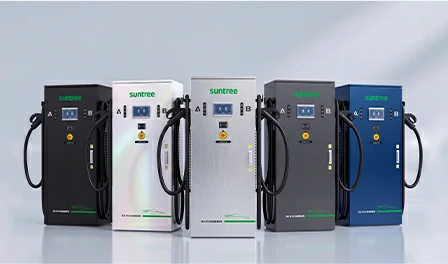
The DC fast charger portfolio includes the SSJ5E Pro/Max (120kW to 240kW), SSJ3E (60kW to 120kW), SSJ4E (40kW to 120kW), and SSJ5E (60kW to 360kW)—all engineered for multi‑charger site layouts and phased expansion strategies. AC charging models—SWJ3E, SWG7, SWG5E, SWJ7E/SWJ6E, SCJ4/5, SPJ2E (11kW to 22kW), SPJ3E (3.5kW to 7kW), and SPG3E (7kW to 22kW)—support workplace, residential, and retail scenarios with integrated payment readiness and reliable status reporting.
Trusted by 3,000+ clients across 110+ countries, with real deployments in North Macedonia, Malaysia, Switzerland, and Timor‑Leste, Suntree helps CPOs and site owners start with today’s traffic and expand as demand grows. The company maintains 24 branch offices in Sweden as a European hub, offering competitive pricing, technical training, and dedicated support for distributors, installers, and system integrators.
Rather than forcing a “rip‑and‑replace” cycle every time compliance or capacity targets shift, Suntree‘s modular platforms allow phased site growth. Operators can deploy the chargers they need today, then add capacity as traffic and grid approvals allow—turning what could be a risky compliance exercise into a predictable rollout plan.
→ Request a configuration recommendation from Suntree — Share your corridor locations, current site power constraints, and target rollout timeline. Their technical experts will recommend the right mix of DC fast chargers and storage solutions for your network.