 Jun 20,2026
Before 2024, the EU‘s Alternative Fuels Infrastructure Directive left member states to interpret “enough chargers” differently. Coverage gaps, confusing payment methods, and unreliable station data were the norm. That era ends with AFIR—Regulation (EU) 2023/1804—which shifts from non‑binding guidance to enforceable milestones starting in 2024. For charge point operators and site owners, AFIR demands more than just installing hardware. It requires corridor coverage along TEN‑T routes, ad‑hoc payment options for occasional drivers, transparent pricing displayed before charging, and reliable real‑time status data. This guide explains AFIR’s four practical pillars, the timeline that matters, and how Suntree‘s EV charging and solar conversion solutions help you stay ahead—whether you’re a distributor, installer, or site operator.
Fewer “charging deserts” along the TEN‑T corridors
The core of AFIR is eliminating coverage gaps on Europe‘s main transport routes. For passenger cars, phased power capacity and station spacing requirements along TEN‑T corridors take effect from the mid‑2020s. For heavy‑duty trucks, AFIR also drives corridor readiness, pushing the market toward higher‑power logistics hubs. In practice, a driver crossing from Germany to France should no longer face a patchwork of unreliable stations. But grid constraints remain the real bottleneck—transformer lead times and permits often stretch to 24 months. Securing site capacity early is the only way to meet AFIR deadlines. Suntree’s portfolio includes scalable DC fast chargers from 60kW to 360kW (SSJ5E Pro/Max, SSJ5E, SSJ3E, SSJ4E) that let you deploy the capacity you need today and expand as requirements tighten without forcing a “rip‑and‑replace” rebuild.
Less payment friction for ad‑hoc users
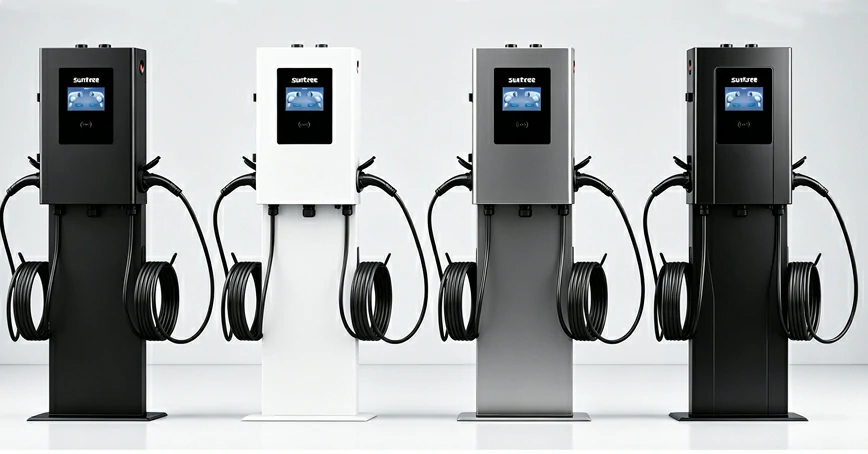
One of AFIR‘s most visible changes is making public charging accessible for drivers who don’t want to join a specific ecosystem. Charging should feel closer to everyday payments: contactless bank cards, mobile wallets, or roaming solutions that work without app downloads or account registration. For CPOs, this means hardware that supports universal payment readers, backend settlement integration that doesn‘t create reconciliation headaches, and clear terms displayed before the session starts. Suntree’s AC charging stations—SWJ3E (7kW to 22kW), SWG7 (7kW to 22kW), SWG5E (7kW to 22kW), and SWJ7E/SWJ6E (7kW to 22kW)—are built with payment‑ready architectures that can adapt to evolving compliance expectations without expensive retrofits.
Clearer pricing, fewer surprises
AFIR requires that pricing rules be displayed clearly before charging begins—or at least before the session is finalized. The price logic shown to the user must match what the backend billing and roaming settlement systems actually apply. This is not a “UI checkbox.” It demands tight integration between hardware, central management systems, and any roaming platforms used. Even small mismatches can create disputes, refunds, and compliance exposure. Suntree‘s SCJ4/5 (7kW to 22kW) and SPJ2E/SPJ3E/SPG3E (3.5kW to 22kW) models are designed with billing logic consistency across hardware generations, making it easier to maintain audit‑ready records and display‑backend synchronization.
More reliable real‑time status data
AFIR mandates that operators provide accurate availability information: available, occupied, or out of service. The data that feeds maps, in‑car navigation, and trip planners must reflect actual site conditions with higher reliability. This requires robust connectivity, sensors that correctly detect plug presence, and back‑end logic that distinguishes “occupied by a charging EV” from “blocked or offline.” Suntree‘s full range of AC and DC chargers—from compact home units to high‑power corridor stations—integrates with modern network management platforms, supporting the data quality AFIR expects. For sites that need additional capacity management, Suntree’s commercial energy storage systems can help manage peak loads and maintain station uptime where grid upgrades are still pending.
The AFIR timeline: what to expect and when
| Year | Key Milestone | Impact on CPOs and Site Owners |
|---|---|---|
| 2024 | Regulation applies; compliance shifts from planning to delivery | Begin site assessments, hardware upgrades, and grid applications |
| 2025 | Early corridor coverage requirements become enforceable | Long‑distance corridors must meet power and spacing milestones |
| 2027 | Digital readiness and operational transparency tighten further | Audit‑ready billing logic and reliable status data become mandatory |
| 2030 | Full maturity for TEN‑T coverage and heavy‑duty readiness | Logistics corridors must support high‑power truck charging |
The real challenge isn‘t the final 2030 date—it’s the lead time for grid upgrades, permits, and equipment procurement. Suntree‘s global manufacturing footprint—20+ production lines with high‑volume capacity and full CE, TUV, UL, RoHS, and UKCA certifications—helps partners scale without supply chain delays.
Common questions from CPOs and installers
Q: Does AFIR require card payment on every public charger?
The regulation pushes ad‑hoc charging to be practical and reduces reliance on closed subscription ecosystems. Contactless payment readers (or equivalent) are the expected norm for new public fast chargers. Suntree’s charging platforms are designed with payment‑ready architectures that can accommodate regional variations.
Q: What‘s the single biggest obstacle to AFIR compliance?
Grid lead times. Transformer availability and permit approvals can take 18–24 months in many regions. Suntree’s commercial energy storage solutions help bridge capacity gaps while permanent grid upgrades are completed.
Q: Does AFIR apply to AC destination chargers?
The regulation covers public charging broadly, but corridor coverage requirements focus more heavily on DC fast charging. However, AC chargers in public locations still need to meet payment and transparency rules. Suntree‘s full AC lineup—SWG5E, SWJ7E, SCJ4/5, SPG3E—supports these requirements out of the box.
Q: How should I choose charging equipment with AFIR in mind?
Look for scalable systems with consistent billing logic, reliable status reporting, modular architectures that allow capacity upgrades without full replacement, and clear data retention for audits. Suntree’s portfolio, trusted by 3,000+ clients across 110+ countries with 24 branch offices in Sweden as the European hub, is engineered for phased growth—not forced rebuilds.
Suntree: your partner for AFIR‑ready infrastructure
Suntree has been a global provider of solar and EV charging solutions since 2007, focusing on new energy, smart power, and grid technologies. With 100+ R&D personnel dedicated to continuous innovation in power electronics and 20+ production lines ensuring high‑volume quality control, Suntree supports distributors, installers, and system integrators worldwide. Full certifications—CE, TUV, UL, RoHS, UKCA—mean Suntree equipment meets global market access standards, including those for EU public tenders subject to AFIR.
Beyond hardware, Suntree offers competitive pricing, technical training, and dedicated support for partners. Whether you need AC destination chargers for workplace and residential scenarios, DC fast chargers for fleet and logistics corridors, or solar+storage+charging integration, Suntree translates technical specs into business value. With real deployments in North Macedonia, Malaysia, Switzerland, and beyond, Suntree has the global experience to help you navigate AFIR‘s phased rollout.
The window to act is narrow. Grid approvals and equipment lead times won’t wait. Partnering with an experienced supplier that understands corridor planning, site constraints, and scalable deployment reduces risk and improves rollout predictability.
→ Request an AFIR‑oriented configuration from Suntree — Share your corridor locations, site power constraints, and rollout timeline. Their technical experts will recommend the right mix of AC and DC chargers and storage solutions for your network.